- 43
- 1
- 0
- 0
- 0


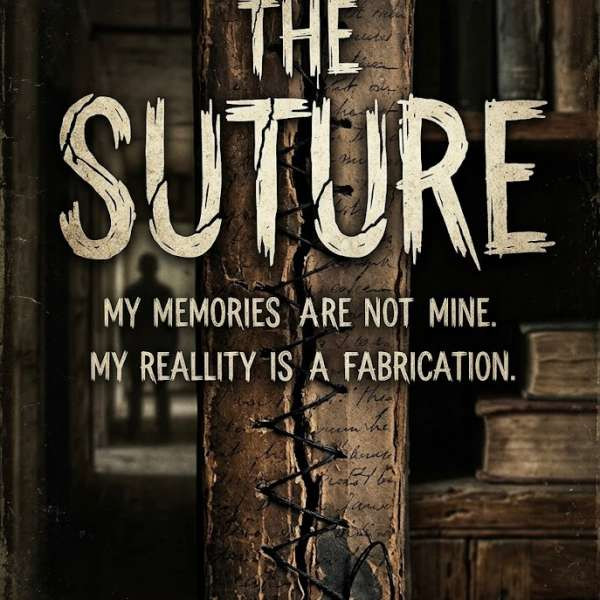
A psychological thriller that follows a man who discovers his domestic reality is a curated experiment. As he begins to notice his belongings shifting and his own handwriting appearing in documents he never authored, he is forced to confront the terrifying possibility that his memory is not a record of his life, but a fabrication designed to be observed. The story tracks his desperate, fracturing attempt to verify his own identity as the boundaries of his home—and his mind—begin to dissolve
Title: The Suture
Description: A psychological thriller that follows a man who discovers his domestic reality is a curated experiment. As he begins to notice his belongings shifting and his own handwriting appearing in documents he never authored, he is forced to confront the terrifying possibility that his memory is not a record of his life, but a fabrication designed to be observed. The story tracks his desperate, fracturing attempt to verify his own identity as the boundaries of his home—and his mind—begin to dissolve............
The spine of the book feels wrong. It is thicker than it was yesterday. Or perhaps it is thinner. My copy of The Glass Suture usually sits flush against the edge of the mahogany shelf, precisely three inches from the brass bookend. I slide my finger along the top edge, feeling the indentation of the binding. It sits a fraction of an inch further back than it did this morning. Maybe the shelf is warping. Old houses breathe, I suppose. I push the book forward until it is flush again, then walk to the kitchen to start the kettle. The hum of the refrigerator is louder than usual, or perhaps the house is just quieter today. I leave the stove on, wait for the whistle, and return to the living room. The book has moved back again. It is sitting in the exact position it occupied before I moved it. I tell myself I must have misjudged the alignment. My eyes are tired. That is all.
The envelope is tucked inside the book. It is a heavy, cream-colored stock I do not recognize. I open it, finding a single page covered in my own handwriting. The ink is black, precise, and entirely unfamiliar. It recounts a conversation I had with Elias about a dinner we never attended. We discussed the wine, a vintage I have never tasted, and the argument that followed. I remember the night clearly, but we spent it here, on the sofa, watching the rain against the window. I set the letter down and walk to the hallway mirror. My face is steady. I check the date on the wall calendar. It is correct. I check the desk drawer where I keep my stationery. The paper is white, lined, and thin. Not cream. Not heavy. I touch the letter again. It feels cold. I turn it over. There is no return address. Just my name, written in a hand that looks more like mine than mine does. I assume I must have written it in my sleep. I am stressed. That is the only logical explanation.
Elias returns home at six. He hangs his coat on the hook, the same rhythmic click of metal on wood that has defined my evenings for two years. I am waiting in the kitchen. I ask him about the dinner we supposedly had. He laughs, pouring a glass of water, his back to me. He says he has no idea what I am talking about. The casual dismissal is perfect. It is exactly how he should react if I were imagining things. But then he turns around, and his eyes linger on the empty chair at the table. He says it is a shame about the wine, as if he suddenly remembers it. The discrepancy pulls at the air between us. I check the counter for the letter. It is gone. I look at his hands. He is holding the glass, but his fingers are twitching, a subtle, rhythmic tapping against the wet glass. I ask him where he put it. He asks what I am talking about. I know the letter was there. I was holding it. Now, the counter is bare.
I wait until he is asleep. The house is silent, save for the rhythmic groan of the floorboards. I retrieve my spare key and open the bottom drawer of his desk. I have never looked in here before. I find a stack of envelopes, all cream-colored, all addressed in my handwriting. I open the top one. It is a log of my movements for the past week. Every time I left the room, every time I paused to look at the books on the shelf, every time I checked my reflection in the mirror. My pulse hammers in my throat. I feel the room tilt. I reach out for the desk to steady myself, but my hand misses, and I knock a glass of water off the surface. It shatters. I am on my knees, surrounded by shards. Elias is standing in the doorway. He is not surprised. He does not ask what I am doing. He just says, you were supposed to sleep through that part.
I run to the bedroom and lock the door. My hands are shaking so violently I can barely turn the key. I need to know. I find my notebook under the mattress, where I have been tracking the books on the shelf. I compare my notes to the books in the room. The titles are changing. I look at the spine of the volume I thought was The Glass Suture. The title is different. It is a medical ledger. I open it. It is filled with entries in my handwriting, documenting my reactions to an experiment I have no memory of consenting to. I am the subject. I have always been the subject. The floor seems to liquefy beneath me. I look at my own hands. I do not recognize the ring on my finger. It is a band of silver I have never seen, yet it feels as if it has been fused to my skin for years. I am not the observer. I am the data.
I leave the house through the window. I do not know where I am going, but I need to see if the world outside is as thin as the one inside. I reach the street corner, but it is not a street. It is a row of shelves, stretching infinitely into the dark, lined with books that bear my name. I pull one from the shelf. It is a record of my childhood, but the names of my parents are not the ones I remember. I drop the book. It hits the ground with the sound of a closing door. I hear Elias behind me. He is not angry. He is checking a watch that does not have hands. He says it is time to reset the sequence. I realize then that the house was never a home. It was a container.
I wake up in the kitchen. The kettle is whistling. It is a piercing, familiar sound. I reach for the tea, my movements fluid and automatic. The book sits on the mahogany shelf, three inches from the brass bookend. I touch the spine. It is perfectly flush. I pick up a pen and a piece of paper to write a reminder, but as I set the nib to the page, I pause. I look at my handwriting. It is the same script I saw on the cream-colored letter. I look at the clock. It is six. I hear the front door open, the sound of a coat being hung on the hook, the click of metal on wood. I know he is coming. I look at the blank page. I wonder if I should write a warning, or if I have already written it a thousand times before. I pick up the pen. I begin to write my own name. It feels like someone else is holding my hand. I wait for the sound of his footsteps, wondering if I will recognize them, or if I will simply decide that they belong to me.
最近收听的


没有找到评论
更多曲目