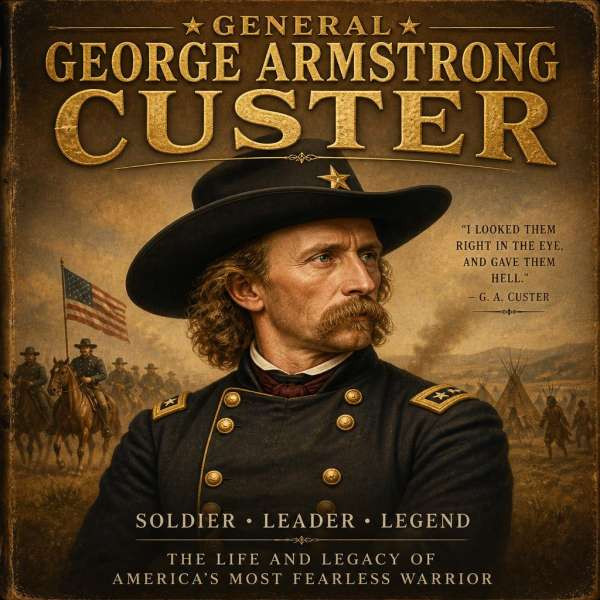


This biography strips away the myth of the "Boy General" to examine the volatile life of George Armstrong Custer. From his meteoric rise during the Civil War to the tactical arrogance that led to the total annihilation of his command at the Little Bighorn, the book offers a cold, analytical look at a man driven by an insatiable need for glory. By contrasting his public image as a heroic martyr with the brutal reality of his frontier campaigns, The Gilded Failure explores how a singular act of hubris—and a calculated posthumous public relations campaign—forever cemented his place in American history.
General George Custer Biography
Chapter 1: The Boy from New Rumley
Born in 1839 in the tiny hamlet of New Rumley, Ohio, George Armstrong Custer was the eldest son of Emanuel and Maria Custer. His childhood was defined by the modest, rigorous environment of a frontier-era household. He was an energetic youth, often restless and deeply conscious of his family's working-class status. These early years instilled in him an intense, burning ambition to distinguish himself. He did not want to remain a simple boy from a small town; he sought the recognition and status that he felt his natural abilities warranted, planting the seeds for his lifelong, obsessive pursuit of glory.
Chapter 2: The West Point Crucible
Custer’s enrollment at West Point in 1857 was a gamble that initially seemed doomed. He arrived with little formal preparation, struggling academically in almost every subject. His personality—boisterous, prone to elaborate pranks, and frequently insubordinate—kept him in constant conflict with the strict faculty. He accumulated a staggering number of demerits, finishing at the absolute bottom of the class of 1861. However, the timing of his graduation was his salvation; as the Union scrambled for officers at the start of the Civil War, the need for warm bodies in uniform overshadowed his poor academic performance.
Chapter 3: The Boy General
The chaos of the Civil War served as the perfect theater for Custer’s specific brand of leadership. He was fearless, often leading cavalry charges from the very front, which earned him a reputation for invincibility. His flair for the dramatic, highlighted by his custom-made, velvet-adorned uniforms and long, flowing golden hair, made him a darling of the Northern press. By 1863, he had been promoted to brigadier general at age 23, the youngest in the Union Army. He was instrumental in pivotal engagements, most notably at Gettysburg, where his cavalry actions prevented Confederate forces from breaking the Union flank.
Chapter 4: A Life of Romance and Scandal
In 1864, Custer married Elizabeth "Libbie" Bacon, a woman from a prominent social background who became the central figure in his personal world. Their marriage was marked by intense mutual devotion, though it was not without strain, fueled by Custer’s high-pressure career and his volatility. Libbie was more than a spouse; she was his greatest advocate and, after his death, his protector. While their public image was that of a storybook couple, Custer’s professional relationships were often volatile, as his arrogance and refusal to brook disagreement earned him as many enemies within the military ranks as he had admirers in the public.
Chapter 5: The Frontier and the Court-Martial
When the Civil War ended, Custer’s transition to the U.S. Army’s frontier service was jarring. The rigid, slow-moving pace of peacetime military life clashed with his need for constant action and personal recognition. In 1867, his frustration boiled over, leading to his court-martial for unauthorized absence—he had left his post to visit his wife—and for the misuse of government cavalry horses during the journey. The proceedings stripped him of his rank for a year, a humiliation that stung deeply and fostered a permanent sense of resentment toward the military bureaucracy.
Chapter 6: Wa****a and the Indian Wars
Custer’s return to active duty brought him into the heart of the government’s brutal campaign to pacify the Great Plains. In November 1868, he orchestrated a dawn surprise attack on Black Kettle’s Cheyenne village at the Wa****a River. While he framed the event as a grand tactical victory, the reality was a massacre of a village that was largely composed of non-combatants. The event solidified his reputation among the plains tribes as a ruthless adversary, while providing him the headline-grabbing win he desperately craved to rehabilitate his public standing.
Chapter 7: The Black Hills Expedition
In 1874, Custer was tasked with leading an expedition into the Black Hills, a region sacred to the Lakota and legally protected by the 1868 Treaty of Fort Laramie. Ostensibly a reconnaissance mission, Custer’s announcement that his party had discovered gold in the hills triggered a massive, uncontrollable stampede of prospectors. This breach of faith by the U.S. government made conflict with the Lakota inevitable, as the government prioritized the economic potential of the land over its treaty obligations to Indigenous nations.
Chapter 8: The Road to Little Bighorn
By 1876, the U.S. government was desperate for a victory to justify its ongoing war against the Lakota and Cheyenne. Custer, seeking to reclaim the prestige he felt he was losing, led the 7th Cavalry into the Montana Territory. Throughout the march, he ignored warnings from his scouts regarding the massive size of the enemy camp. He was convinced that the tribes would scatter upon his arrival. Driven by the fear that the glory of the campaign would be stolen by other commanders, he pushed his men hard, arriving at the Little Bighorn with a singular focus on an immediate, decisive strike.
Chapter 9: The Last Stand
On June 25, 1876, Custer surveyed the valley of the Little Bighorn and found the largest gathering of plains warriors he had ever seen. Rather than wait for reinforcements, he ordered a three-pronged attack, dividing his already overextended force. Custer’s battalion was cut off and forced onto a ridge, where they were rapidly overwhelmed by the sheer numerical superiority of the Lakota and Cheyenne warriors. The combat was ferocious and brief, resulting in the total destruction of five companies of the 7th Cavalry, leaving no survivors from Custer’s immediate command.
Chapter 10: The Making of a Myth
The immediate reaction to the defeat was one of national shock, but the narrative pivot began almost immediately. Libbie Custer, working tirelessly with journalists and historians, curated a version of events that transformed a disastrous tactical defeat into a noble, heroic sacrifice. By emphasizing Custer’s bravery and framing the battle as a tragedy born of overwhelming odds, she successfully shielded his name from blame. For decades, the "Boy General" was immortalized in paintings and literature as a martyr of the frontier, a myth that successfully buried the tactical failures and brutal realities of his final command.
Recientemente escuchado por


No se encontraron comentarios
Más pistas