- 23
- 1
- 0
- 0
- 0


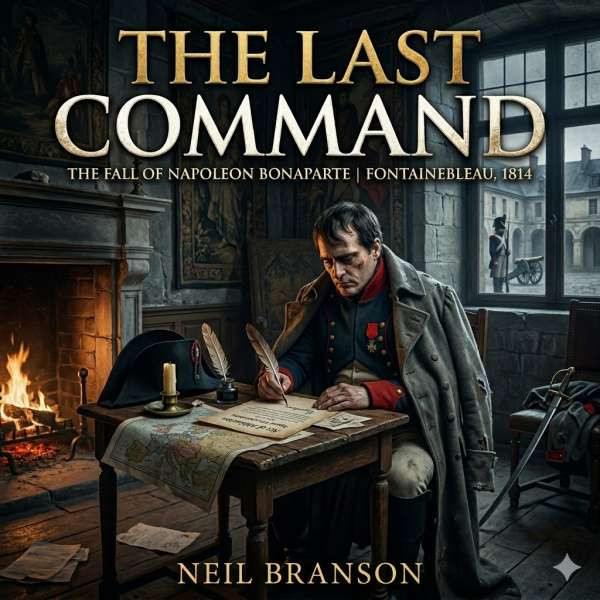
The Last Command
The Old Guard waits in the silence of the courtyard, but their Emperor is alone. Stripped of his glory and abandoned by his marshals, Napoleon Bonaparte sits before a scrap of vellum to do the only thing he has never done before: surrender. This is the story of the man behind the myth, in his final hours of absolute power.
The Old Guard waits in the silence of the courtyard, but their Emperor is alone. Stripped of his glory and abandoned by his marshals, Napoleon Bonaparte sits before a scrap of vellum to do the only thing he has never done before: surrender. This is the story of the man behind the myth, in his final hours of absolute power.
The room in the chateau at Fontainebleau was cold, even with the fireplace crackling in the corner. It was April in eighteen fourteen. Outside the heavy stone walls, the French forest was beginning to bud, but inside, the air felt static, trapped by the presence of a man who had commanded half a continent. Napoleon Bonaparte sat at a small mahogany table, his uniform discarded over the back of a chair. His fingers traced the edge of a map that showed a France smaller than the one he had inherited. Beside his hand lay a quill, its tip frayed from use.
The soldiers in the courtyard below were silent, their muskets resting against the damp stone. They were the Old Guard, men who had followed him across the burning sands of Egypt and through the snow-choked wastes of Russia. They did not talk. They only waited.
The news from Paris had reached the gates two days prior. The senate had defected. The allies were at the city walls, and his marshals, the men who had shared his wine and his glory, had informed him they would fight no more. The pressure was a physical weight, pressing down on the rafters of the room. It was not merely the loss of a throne, but the dissolution of an entire logic of power.
Marshal Ney had stood in this same room just hours ago. He was a man of mud and iron, his coat stained from the recent fighting. Ney had looked Napoleon in the eye and spoken the words that confirmed the impossible. According to the memoirs of the secretary Baron Fain, Ney had told him with a directness that lacked any shred of military formality that the army would follow their generals, not their emperor.
Napoleon had reached for the inkwell, his movements slow, deliberate. He knew the alternatives. He could call for the cavalry and march on Paris, a final, desperate gamble that would leave the capital in flames. He could refuse to yield, turning his final stand into a massacre of his own veterans. The choice was not between victory and defeat. It was between a transition and an ending. He looked at the window, at the grey sky that promised rain, and he felt the shift in the balance of the world. The era of the revolutionary crusade was reaching its conclusion.
He pulled a sheet of heavy vellum toward him. He did not call for his secretaries. He did not consult his ministers. He took up the pen, dipped it deep into the black ink, and began to write. The scratch of the nib was the only sound in the room, harsh and rhythmic. He wrote that he renounced for himself and his heirs the thrones of France and Italy.
The sentence was simple. It lacked the grand flourishes of his bulletins from the front. It was a cold, legal instrument of surrender. He finished the lines, his hand steady, and then he paused. The silence in the room deepened. This was the threshold. If he did not sign, the bloodbath would continue. If he did sign, the map of Europe would be redrawn by men who had spent twenty years in fear of him.
He pressed the quill to the paper. The ink bloomed into a firm, distinctive stroke. He signed his name.
And then it was DONE.
The world had fractured. The man who had been the sun around which all of Europe revolved was now a private citizen in a chateau that smelled of woodsmoke and old dust. A guard outside in the courtyard shifted his weight, his boot scraping against the stone. The sound seemed unnaturally loud. It was the last time the soldiers would look to him for the order to charge. The last time the marshals would hesitate before deciding their own fates. The last time the borders of nations would be dictated by the movement of his personal carriage.
The news traveled faster than a horse. By the next morning, the post-riders were already miles away, carrying the tidings to London, to Vienna, to Saint Petersburg. In the small villages along the route, the bulletin was read aloud in the squares. Peasants who had lost sons to his campaigns stopped their work to listen. Some cheered, waving their caps in the air. Others stood in mute disbelief, unable to conceive of a France without the man who had defined their waking lives. The news hit the markets of London with a sudden, violent drop in the price of gold, as the speculators scrambled to adjust to a peace they had deemed impossible.
The ripple moved outward. Within weeks, the map was being spread out on tables in Vienna. Diplomats who had been in hiding for years emerged to claim their seats, intent on turning back the clock to a time before the barricades. The old monarchies, which had been shaken to their foundations, began to reassert their authority, grafting new laws onto old, rotted structures.
The path from that room in Fontainebleau leads directly to the world we inhabit today. The treaty signed that day established the precedent for a Europe managed by consensus rather than conquest, a system of alliances that would define the next century of statecraft. The borders of modern France, the configuration of the German states, the very notion of a concert of nations—all of these emerged from the ink that dried on that vellum.
The Last Command
We live in the shadow of that signature. Every border we cross, every diplomatic summit that occurs in a sterile room in Geneva or Brussels, is a faint echo of the moment he laid down the pen. It is a strange, jarring thing to consider that the fate of millions once hung on the decision of a single man in a drafty room, sitting in his stocking feet, deciding that the battle was over. The forest outside continues to grow, indifferent to the men who once marked the trees with their ambition. The chateau remains, a quiet stone box where the world changed while a fire burned low in the grate.
استمع مؤخرا من قبل

لم يتم العثور على تعليقات
المزيد من المسارات