- 61
- 1
- 0
- 0
- 0


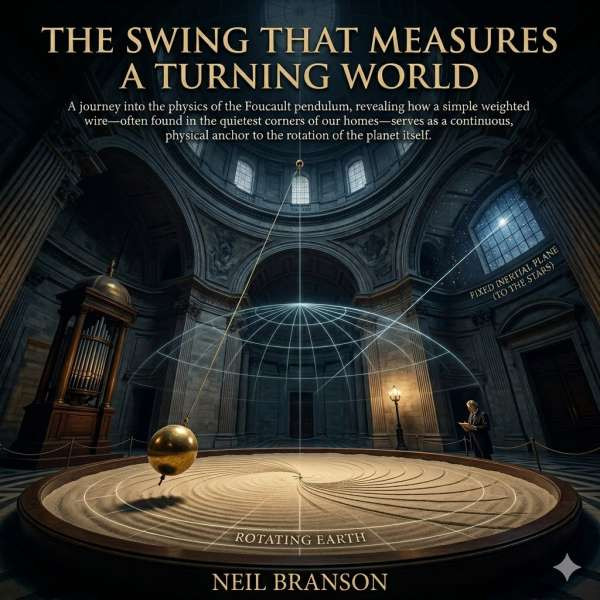
The Swing That Measures A Turning World
A journey into the physics of the Foucault pendulum, revealing how a simple weighted wire—often found in the quietest corners of our homes—serves as a continuous, physical anchor to the rotation of the planet itself.
A journey into the physics of the Foucault pendulum, revealing how a simple weighted wire—often found in the quietest corners of our homes—serves as a continuous, physical anchor to the rotation of the planet itself.
The Swing That Measures A Turning World
A journey into the physics of the Foucault pendulum, revealing how a simple weighted wire—often found in the quietest corners of our homes—serves as a continuous, physical anchor to the rotation of the planet itself.'''''''''''''''
The heavy pendulum of the clock in your hallway swings with a rhythmic, predictable thud. It is a weight attached to a rod, pivoting at a fixed point, obeying the gravity of the Earth. If you nudge it, it swings in a single plane, slicing through the air back and forth until the friction of the hinge and the resistance of the air eventually bring it to a stop. It is a machine that captures a constant, ticking progress. But imagine that pendulum not in your hallway, but sitting on the floor of a cavernous room in the Paris Observatory in eighteen fifty-one. Léon Foucault is there, watching as he sets a sixty-seven-meter wire in motion. He is not trying to measure time. He is trying to demonstrate the movement of the planet itself.
The pendulum begins to trace a line across a circular bed of sand beneath it. Over the next hour, the line does not retrace its path. It drifts. A witness in the room sees the pendulum slowly carving a circle, the marks in the sand rotating clockwise.
How does a weight swinging on a string know that the floor beneath it is turning?
The conventional model of our experience is that the ground is solid and stationary. We walk on it, we build on it, and we trust it to stay put. When you see a pendulum swing in your living room, you assume the arc it carves is fixed in space, governed entirely by the interaction between the weight and the gravitational pull of the Earth. You expect that if the pendulum is swinging north to south, it will continue to swing north to south until the energy drains away. The motion is local. The room is the frame of reference.
And it almost works.
But here is where the model breaks. When Foucault released his pendulum, he knew that the plane of oscillation should be inertial—it should remain fixed in its orientation relative to the stars, regardless of the Earth spinning underneath it. If the Earth were truly stationary, the mark in the sand would never shift. Yet, within twenty minutes, the pendulum was clearly deviating from its starting line.
The anomaly is not that the pendulum is changing its direction. The anomaly is that the pendulum is staying exactly where it started, while the entire building, the city of Paris, and the ground itself rotate around the Earth’s axis. The pendulum is an anchor to the heavens, and the Earth is a sphere slipping out from underneath it.
To understand this, we have to move away from the clock in your hallway and onto a rotating disc. Imagine a large, frictionless merry-go-round. You stand at the very center, holding a ball. You throw the ball toward a friend standing at the edge. To you, at the center, the ball travels in a straight line. But to your friend, as the platform rotates, the ball appears to curve away, as if pushed by an invisible hand.
That is the first layer of the mechanism. Inertia is a stubborn persistence. An object in motion stays in motion in a straight line unless acted upon by an outside force. When you throw the ball, it follows its own straight path through space, independent of the platform's rotation. The curvature is an illusion caused by your friend moving into a new position while the ball is still in the air.
This leads us to the second layer. Foucault’s pendulum is essentially doing the same thing as that ball, but on the surface of a globe. Because the Earth is a sphere, every point on the surface—except for the North and South Poles—is rotating around the axis at a different angle. At the equator, you are moving in a massive, circular sweep. As you move toward the poles, that circle tightens.
The pendulum at the pole is the simplest version. As the Earth completes one full rotation in twenty-four hours, the floor turns completely under the pendulum, making the swing appear to rotate through a full three hundred sixty degrees. But if you move the experiment to Paris, the rotation is slower, tilted by the latitude. The Earth is not just a platform; it is a tilted, spinning frame, and the pendulum is the only thing in the room that refuses to participate in the spin.
The interaction between these two motions creates the path in the sand. The pendulum is a bridge between the local, grounded room and the absolute, rotating framework of the planet.
And that changes everything.
The ground is not a static stage. The ground is a participant in a continuous, planetary motion. You are not standing on a fixed surface; you are riding a spinning sphere through the vacuum of space.
This reveals that our perception of stillness is a local convenience. We feel the ground beneath our feet as solid and unmoving because our lives are measured in seconds and meters. But the pendulum strips away that illusion. It demonstrates that we are constantly in motion, turning through the sky every single day.
Go back to your hallway. Look at the clock. The pendulum is not just measuring the passing of minutes. It is a physical link to the rotation of the world. It is swinging in a plane that ignores the floor, the walls, and the foundation of your house. Every time it completes a cycle, it is maintaining its orientation to the distant, silent stars, while you, your house, and your entire neighborhood are carried in a long, slow arc around the axis of the Earth.
The clock is not just a timer. It is a compass that traces the invisible spin of our home.
استمع مؤخرا من قبل


لم يتم العثور على تعليقات
المزيد من المسارات